

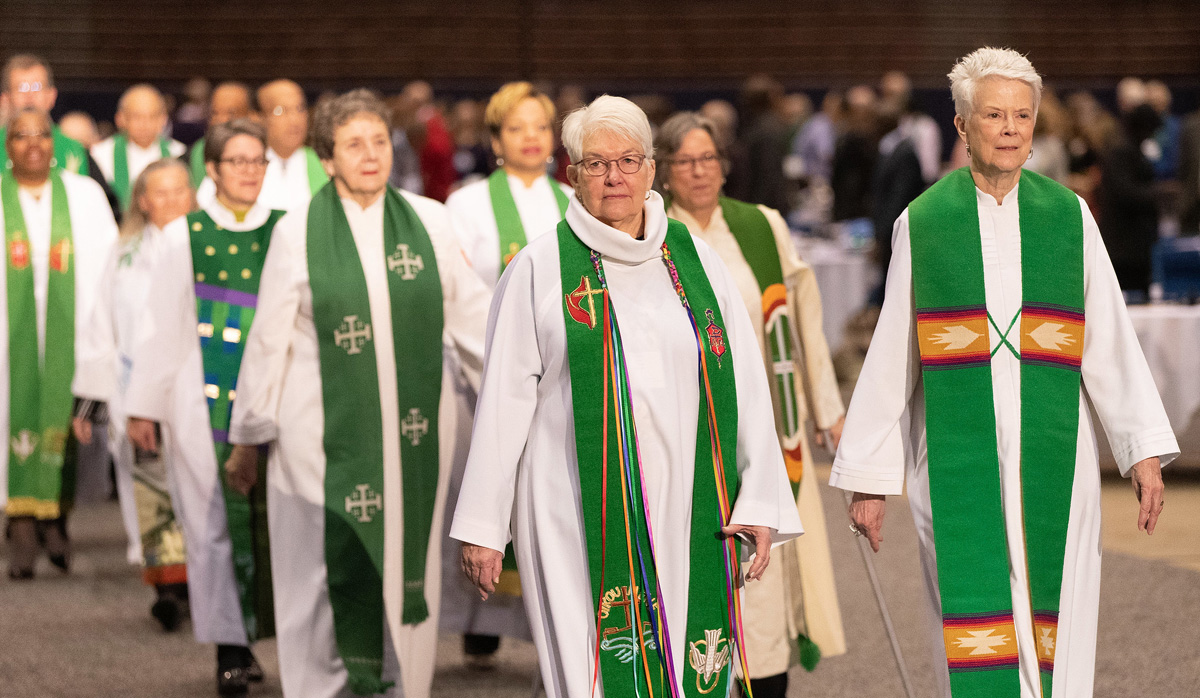
Should churches ordain female elders and preachers?
A 2020 study found that three-quarters of self-identified Evangelicals believe that women should be allowed to preach and serve as elders in the local church. Many younger members see men-only policies as sexist and discriminatory.
Complementarians (who believe in separate roles for men and women) keep losing this battle because they’re basing their arguments on the question on authorization. Who is authorized by scripture to serve as a pastor or elder? They quote their favorite Bible verses, while their opponents (the egalitarians) quote theirs. In the end few minds are changed.
Complementarians would be wise to shift their focus from authorization to outcome. We now have 50+ years of evidence that proves that, almost without exception, churches that shift to egalitarian governance become “Grandma-cracies” — led by a cadre of older women who, despite their best efforts, set the church on a path of decline.
Women step up. Men step back.
Churches that open their governing boards to women envision a future in which both genders work hand-in-hand to benefit the church. But this isn’t what happens. In almost every case the board transitions from male dominated to female dominated within a generation. As the women step forward, the men step back.
Over time these women age, and the “Grandma-cracy” is born. These older women tend to prioritize preservation over progress, and relationships over rules.
Soon the entire church is female-led. The lay ministries, the volunteer ranks and the formal leadership positions are almost all held by women. In the absence of men, the church flounders.
Now, let me clarify 3 things:
- There are plenty of complementarian churches that are also in decline. But egalitarianism seems to accelerate the downhill slide in attendance, involvement, donations, etc.
- Some Pentecostal denominations that were egalitarian from the beginning (such as the Assemblies of God) continue to grow and have resisted the pull toward theological liberalism. But in practice, these churches are almost always led by men.
- I’m not blaming women – or men – for the decline. I’m just a reporter: and here’s what I’m seeing, as simply as I can put it: When women lead, men step back and let them. This is true not only in church but also in service clubs, social organizations and institutions that were once male-only. Over time women shoulder more of the burden while men quietly head for the exits. I’m not saying this is good or proper. But it happens.
A little history

America’s seven largest mainline denominations (Presbyterian, Methodist, Lutheran, United Church of Christ, American Baptist, Disciples of Christ and Episcopal) reached their peak during the 1950s and early 1960s. All were male elder governed. They grew numerically, missionally, and physically, building an extensive network of properties that still dot America’s cities and towns.
But in the late 1960s, one-by-one these denominations began admitting women to their governing boards. Almost immediately these churches saw:
- A shift in emphasis: evangelism was out; social justice and community service was in.
- Failure to modernize
- A drift toward progressive theology
- Rapid numerical and financial decline
- Shuttering of thousands of churches
Here’s the nine-step process that led these churches down the path of decline:
Step 1: The church opens the governing board to female elders
The first few women break the glass ceiling to much celebration and applause. The board remains mostly male for a few years. Nothing much changes.
Step 2: The board becomes majority female
Over the years more women step forward to lead, while the men step back and let them. In most cases, the men aren’t angry or resentful – they’re relieved. Many men perceive women as more qualified to lead in the church, since most volunteer opportunities in the church revolve around music, children, relationships, care for the suffering and hospitality – areas where women tend to have more experience. “Women have got church covered,” the men think to themselves. “I’m going fishing.”
The problem compounds itself as the board becomes majority female. Men are much less likely to volunteer as the token male on a female-dominated board.
Step 3: The board becomes a “grandma-cracy”
Within a generation, the board is led primarily by older, empty-nester women (grandmas) who have the time and energy to devote to church business. In fact, women run the entire church now. Women were already in charge of the children’s ministry, the music ministry and the benevolence programs. Men hardly lead anything in the church — again, because the women seem to have matters in hand.
Over the years, a handful of women cycle on-and-off the board. As these women age, the board becomes as much of a support group as it is a governing body. These “Golden Girls” form tight relational bonds as they care and pray for one another through disease, deaths, family issues, etc.
While these relationships are manna to the women themselves, they can also subject the board to emotional blackmail (see point 5 below).
Step 4: Failure to innovate
While there are always exceptions, grandmothers aren’t usually known for their boldness and innovation. A board composed of grandmas will tend to make cautious decisions that keep the peace.
Everyone recognizes that the church is failing, and change is necessary. But change upsets longtime members. The grandmas on the board can’t bear the thought of angering their longtime friends. So, they vote to maintain the status quo – and the church continues its slow slide into irrelevance.
Ironically, the desire to keep the peace today will often push the church toward radicalism tomorrow. Read on.
Step 5: The board will do anything to preserve relationships
Grandma-led churches often re-interpret scripture in such a way that everyone can feel loved and accepted. This well-meaning effort to preserve relational harmony often leads to theological compromise.
Here’s an example of how this plays out (based on a true story):
Anna is 75. She serves as an elder at St. Martin’s Church. She raised her daughter Bethany (age 53) in the church, who in turned raised her daughter Chloe (age 23) at St. Martin’s.
Chloe goes off to college where she comes to identify as LGBTQ. She falls in love with Darla. Chloe wants to wed Darla at the church she grew up in.
But church policy restricts weddings to heterosexual couples. Chloe sees it as an injustice. She appeals to her mother Bethany and grandmother Anna, who ask the church board to make an exception to the rules so Chloe “doesn’t lose her faith.” Anna tells the board, “This is Chloe’s church. She grew up here. If she can’t get married to the person she loves in her church, our entire family will have to think about leaving.”
Cue the emotional blackmail.
The board is in a tough spot. If they enforce the rules, three beloved members of the church family would be emotionally devastated. Their departure would create a huge hole. Anna has been friends with her fellow elders for decades. Bethany runs the church’s food pantry. And they can’t bear the thought of hurting these precious women.
However, there is a solution: Progressive theology.
Step 6: The church drifts away from orthodoxy toward progressive theology
Progressives tend to see the scripture through this lens: Jesus came to love the poor, the marginalized and the oppressed. He cared more about people than he did about rules, as evidenced by his frequent rebukes of the legalistic Pharisees.
As lesbians, Chloe and Darla are by definition, marginalized people. After much discussion the grandmas decide that Jesus would demonstrate love and acceptance by hosting the wedding. The two men who are still on the board object, but they are outvoted by the women. A church wedding date is set. Invitations go out.
So, Chloe and Darla are married in the sanctuary. In response, a few men stop volunteering. Two families with kids quietly leave the church. But longtime members Anna and Bethany are pleased with the decision. Everyone seems happy. Crisis averted.
Step 7: Theological liberalism begins popping up in other areas
Fresh off their victory over same-sex marriage, progressives in the congregation begin pushing the church to focus more on social justice: antiracism, LGBT advocacy, and atoning for past sins such as colonialism and slavery.
The church’s longtime pastor retires. Unable to find an experienced replacement, the church hires a young, progressive pastor (pronouns she/her) fresh from seminary. She brings with her a neo-Marxist worldview, in which God divides the world into two groups: oppressed and oppressor. Her “prophetic” sermons extend unlimited love and acceptance to the former, while the latter get a weekly scolding from the pulpit. Political activism is emphasized, while the church’s traditional focus on personal holiness and salvation are gradually abandoned.
The new pastor is all about inclusiveness. To that end, she teaches that Jesus is one of many ways to God, and that everyone goes to heaven. Eventually the board of grandmas votes to fly the rainbow flag in front of the church, as a proclamation of its inclusiveness.
Step 8: Young families avoid the church. The children’s programs wither
It’s a mystery: even though young adults tend to be politically liberal, liberal churches struggle to connect with young families.
Parents have always looked to the church to provide moral guidance to their kids. A church with ambiguous standards surrounding sex, gender identity, civil unrest and substance use will appeal to very few parents. Even the most liberal parents are reluctant to jump aboard the transgender train that’s plowing through the nation’s public schools, universities, and media outlets.
Step 9: Young men avoid the church. It eventually dies
Declining churches have one thing in common: a lack of young men. Whereas Jesus was a magnet to young men, liberal churches have a hard time attracting straight young males. Young men will invest themselves in an institution that offers firm rules, a clearly defined mission and an emphasis on personal transformation. A grandma-led church that’s obsessed with nurturing the weak will not stir the hearts of young, adventurous men.
CBF: Conservative to liberal in 1 generation
In 1991, the Cooperative Baptist Fellowship (CBF) broke away from the Southern Baptist Convention (SBC) over the issue of women’s ordination. The founders of the CBF set out to create a denomination exactly like the SBC, prioritizing personal salvation, holy living, missions, church planting and of course, evangelism. The only difference: both women and men would serve as pastors and deacons.
It didn’t turn out that way. Within 20 years the CBF was consumed with conflict over LGBTQ issues. In the past decade the CBF has been losing congregations on both the left and right. Donations have fallen and staff are being laid off. As of 2020, the CBF was planting fewer churches and was down to just 64 missionaries in the field. It’s on its way to becoming another mainline clone as evangelism takes a backseat to a host of social justice causes. Baptist News Global, a news service founded by and partially funded by the CBF, leans so far to the left it’s become a religion-focused replica of The Huffington Post.
In summary: the well-meaning effort to bring “diversity” to the church ends up turning it into a “grandma-cracy” – an institution dominated by older women and their liberal values.
We can dispute the meaning of Bible passages, but there’s no disputing the fact that egalitarianism is a slippery slope toward theological liberalism and church decline. Complementarians, stop focusing on authorization, and start focusing on outcome. Every major denomination that has embraced egalitarianism is in a death spiral.
David Murrow, The Online Preaching Coach, is the author of Why Men Hate Going to Church and many other bestselling books. David is an award winning television producer whose work has been seen on ABC, NBC, PBS, CBS, Discovery Networks, BBC World Service and dozens more. He trains pastors how to make their sermons more watchable, memorable and shareable online.


Amen. I know some fine egalitarians who love the Lord, do evangelism and hold to the truth of the Scripture but they are few and far between. Your track for the demise of church fits the biblical, theological, sociological, and experiential smell test.
You have no idea what is going on with too many young males in this country. They had physically or emotionally absent fathers and grew up playing videogames. They refused to do well in school and most didn’t work hard enough to get into college. They are unfit to be husbands or fathers because their own father gave them no role model. They engross themselves online in the misogynistic manosphere. They have no idea it takes two equal partners to have a successful marriage and family. The Bible will never teach them how to be a proper man. The church will not either. It is up to fathers. But too many are so narcissistic, self-absorbed, and think they are the center of the universe they will never make the necessary sacrifices 24/7 it takes to have a family. At best, you should stop pestering young males and shame their fathers.
Agreed! And women are so tired of shouldering the burden of being both parents and receiving little to no love or support. And then politicians and church leaders shame single moms when they are the heroes desperately trying to hold it all together.
So basically this article says that men are so lazy that they are more than happy to just sit back and let the women do all the work. Maybe that’s why so many women at home pretend to be stupid or incompetent to repair things, etc. If women actually let the men in their lives know how competent they are, the men would do NOTHING. That is just sad. No wonder our world is messed up.
So basically men are so lazy that they are more than happy to just step back and let the women do all the work. Sad.
You have very well sumed up the last 15yrs of my last church
Went from 140 average weekly attendance to 16 per week
The woman rose to decision making positions and the men slowly left
Family men first (took there families with them)
Business men next
Pretty soon the men had no say on anything
And we’re punished for trying to speak up
The congregation ended up being a one generation group,all pensioners
When they started dying off it was the end !
Sorry to hear that. I hope you’re able to find a new church that values the contributions of men.
Sam, Lisa, and John combined have all left comments that explicate in their essence *EXACTLY* why I feel so uncomfortable and unwelcome in any church I try to attend. So I don’t. “Those lazy no-goodnik men need to put down the video games, MAN UP, and marry some single mother who already had her fun and now is ‘desperately trying to keep it all together’ and needs a manwallet STAT. MEN BAD BUT WE NEED YOUR MONEY.”
Like, no. I was raised by a single mother. Video games offer me at least the illusion of having agency, being wanted or needed, and a sense of progression. Women already get all the good jobs (you don’t see too many women in the poorly-paid manufacturing sector or doing heavy labor in warehouses, or at least I haven’t. They get all the air-conditioned positions) they get bonus money to attend school, they get sympathy and assistance whereas I’ve only ever experienced the aforementioned shaming and exhortations to do YET MORE because women.
So I’ll stay home. I get it, dude, I’m not welcome here. There’s nothing for me. No succour. No encouragement. Only guilt and shame. Why would I ever want to sign up for a weekly struggle session? So I’m not going. If prison-bound murderers can be saved without attending a church then so can I.
Wish I knew what I did wrong. I was just born. Didn’t want to be. Wish I hadn’t been. But here I am.
Great article, though. Very astute observation and cause-and-effect description. And brave to post, especially given the comments from those infested with the egalitarian brain-bugs. Thanks.