

We don’t entertain

We train

The League is a new kind of church, based on an ancient blueprint. We offer:

  • Daily personal coaching to each member
  • A training model based on Jesus and the 3, the 12 and the 72
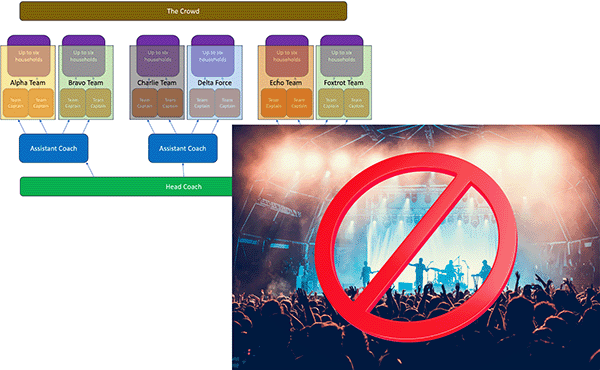
  • More “face time” — and less stage time

Most churches are built around a weekly stage presentation. Community and coaching are optional. The League flips this: we put community and coaching first.

We’re in the idea stage – if you want to launch a League in your community, send me a message.
    Step 1 — Watch this video:

    Step 2 — Review our FAQs:

    Many churches offer great sermons – but there’s no plan to help you live it out. No follow up. No coaching. No action steps to help you live out what you learned. No resources to teach your kids or reach your neighbors.

    The League teaches the Bible every day. During our weekly Meetup the Head Coach briefly introduces a topic for the week (the Game Plan). Then every member gets a daily devotional package called the Playbook. They meet to discuss the Playbook every day in The Locker Room, our server platform. The teams study and practice the same skill together all week long. And there are faith building exercises that help you practice what’s preached.

    Our main act of worship isn’t singing – it’s the Team Reports.

    Twelve team captains assemble and give 1-minute reports on what God did this week in the teams. We praise God not with the lyrics of a song, but with fresh stories of what he is doing among us right now.

    The League doesn’t offer ministry programs of any kind – and that includes children’s and youth ministry.

    Segregating parents and their children into different worship services creates three unintended consequences:

    1. Children never see their parents “doing church.”
    2. Parents and kids hear different lessons at church. For example: Mom and Dad hear a 40-minute sermon about forgiveness. The kids hear a 10-minute message about salvation. They have nothing to talk about (or practice together) after church.
    3. Parents are “farming out” the faith formation of their children to the church. They assume the “experts” in the church will handle it. But multiple studies have shown that parents are the #1 faith influencers of their children. Kids who see their parents (especially their dads) as spiritual leaders tend to stay faithful as adults.

    The League equips parents (through the daily playbook) to disciple their children. We provide family devotions, object lessons and whole-family service opportunities that make parents – not children’s ministers – the spiritual leaders in their homes.

    Each team adopts one target ministry. All the teammates serve in that ministry – even children, when appropriate. By concentrating our efforts (8 households) on a single ministry we make a bigger impact.

    The League meets in rented space – preferably an existing church building that sits empty on Saturday, Sunday or Monday night.

    We only gather once a week and we have no staff, so we don’t need the expense of maintaining a building. We encourage small groups to meet during the week (as they are able) in homes and public spaces.

    We also meet virtually every day in The Locker Room, our server where each team can share prayer requests, ask questions, plan meetups, etc.

    Each team has a private meeting space on a server called The Locker Room. Teammates check in once a day to get their daily playbook (devotional package) and to say hello to their team. The Locker Room is a place where teammates can ask questions, share their inspirations, ask for prayer, and get support from their team captains and coaches. It’s like an old-fashioned prayer chain on steroids. Two team captains act as moderators, keeping the conversation civil and productive.

    The Locker Room is not meant to replace IRL (in-real-life) interactions. Instead, it’s a way to stay in touch daily. In fact, we encourage teammates to plan informal spur-of-the-moment gatherings via The Locker Room.

    Every teammate (and anyone else) can sign up to receive the Playbook. It contains a Bible reading and devotion that help you live out this week’s Game Plan. Every teammate is expected to do this part of the playbook every day. If you only have 10 minutes for the Playbook, that’s fine.

    Bonus content: Each Playbook also contains extra content such as family devotions and object lessons. There are faith building exercises, as well as sermons from respected Bible teachers, podcasts, blog posts, essays etc. If you have the time and want to go deeper this faith-building content will help you execute the game plan.

    The Playbook is not an actual printed book – it is delivered each morning electronically, so you can use it wherever you happen to be.

    Jesus organized his men into teams.

    • He sent the disciples out 2 by 2.
    • He had 3 men in his inner circle.
    • He chose 12 apostles.
    • He later sent out the 72. How were they trained? If 6 pairs of apostles each trained 12 more, you’d have 72. That’s the structure we’re following in the League.

    Bottom line: the Bible is very specific: how you organize people matters.

    No. The team structure is a vehicle for care – not control. The League exerts zero control over people’s finances, relationships or time. Anyone may withdraw from the League at any time.

    Jesus never forced anyone to follow him. In fact, he made it easy for people to leave him if they were unwilling to accept him and his teaching.

    In John chapter 6, Jesus says something so offensive every one of his disciples (except the 12) abandon him. Then he turns to the apostles and says, “Will you also be leaving me?”

    We recognize the League isn’t for everyone. So we maintain a Transfer Portal: a list of local churches they can transfer to if they want to go back to a more traditional church.

    People understand sports. They know what a coach does. What a Team Captain does. What teammates do. These non-churchy terms keep us pointed toward our mission – coaching disciples of Jesus.

    Absolutely! Those who are not yet on a team are welcome to join us for Meetup. And we make invitation easy by building each Meetup around a BIG QUESTION your unchurched friends would probably like to know the answer to.

    Example: Does God care who I sleep with? 

    Instead of inviting your friend to church, invite him/her to hear the answer to that big question. We want to make inviting easy.

    No. We record it and make it available in The Locker Room, our team server.

    We’re following the example of Jesus, who loved women and children, but who built his organization atop a dozen regular guys.

    Every church has spiritual mothers. But spiritual fathers (1 Cor. 4:15) are relatively rare. The League equips men to serve as coaches – answering questions, mediating disputes, and turning people back to Jesus. Plus, the research shows that when women lead, men step back and let them. Over time the women are doing all the “religious” work, while men go fishing. Boys lose interest, and eventually the church declines.

    The roles of women are detailed in Titus 2: Older women should invest in the lives of the younger women, while the younger women accept that mentoring. In the League women do not hold the office of captain or coach, but they are strongly encouraged to mentor and be an example to one another. Women are full participants in every area of the League, especially the Locker Room, and their contributions to these online discussions are valued.

    Jesus limited the number of men in his inner circle. In like manner, we offer a specific number of leadership positions, so as not to burn out our coaches. And we limit each team to six households, so our team captains don’t become overloaded.

    Our leadership philosophy: High expectation. Light yoke.

    A “full” League of 52 households yields about 150-200 people, a comfortable size of congregation that can meet in a variety of rented spaces. Any larger and people tend to disappear out the back door or fall through the cracks.

    Every coach and captain learns the 3 Journeys of Jesus: Submission, Strength and Sacrifice. This is the League’s basic training.

    They also learn practical skills like conflict resolution, hospitality, facilitating discussions, discernment, church discipline and more. They are not theologians – they are coaches.

    We’re not naive. The more people interact, the more likely they are to experience disagreement, conflict and even sin against one another. In the League we anticipate conflict — and use it as a vehicle for growth. Jesus told us how to deal with conflict in Matthew 18.

    In cases of serious conflict/divisiveness/sin a teammate, coach or captain may be removed from the League. We maintain a Transfer Portal to help outgoing teammates find another church.

    Yes. The League is a church, albeit with a different focus, practices and organizational structure than most churches.

    Yes, of course. Whatever makes you a more faithful disciple of Jesus — do it.

    Your building probably sits empty on Saturday or Sunday night. Launch the League as a church-within-a-church.

    It’s not just an alternative worship service – it’s a completely different way of doing and being a church. Think of it as a “graduate program” for longtime churchgoers who are bored of the routine, and who want daily community and coaching.

    Most churches are built on an educational model (lecture style sermons, Bible studies, classes).

    The League is based on a personal coaching model. We organize people into teams so nobody falls through the cracks. We offer daily training (online) to help our team members live out their faith.

    We gather once a week. There are no midweek small groups or program meetings. So we keep the doors open a long time.

    The stage time is 30. Then we hang out – sometimes for hours. Come and go as you please.

    Less stage time means more face-to-face time.

    Short services keep the kids engaged – eliminating the need for a separate children’s church

    Yes. The Team structure is not meant to divide. They’re lines of care and responsibility. The teams (and their teammates) are encouraged to join up and hang out together as much as they want.

    No. However, we teach the Biblical principle of the tithe: giving 10% of your income to charity. We ask that teammates give 3% of their income to support The League and 7% to other worthy causes.

    No. Right now the plan is to launch League #1 in the West Valley of Phoenix, Arizona. God may change this plan – stay tuned.

    If you live in Phoenix you can apply membership in League #1. Click the orange button below to access the application.

    Every League maintains a waiting list. Sign up. In the meantime you can still attend our weekly meetups (as a member of The Crowd) volunteer for some projects and hang out with your friends in the League. The only difference: you won’t be included in the team Locker Room, where the daily interaction occurs, nor will you receive the daily coaching teammates get.

    Meet Comissioner David Murrow

    Coach

    The League is the vision of David Murrow, author of the bestselling book Why Men Hate Going to Church, an inspirational bestseller with more than 150,000 copies in print a dozen languages. The book has been reviewed in newspapers such as the New York Times, USA Today, Chicago Tribune and many others. He’s spoken about the gender gap on the NBC Nightly News, Fox News Channel and PBS. He’s a frequent guest on Christian TV and radio programs such as Focus on the Family and Family Life Today. He’s been interviewed in major Christian publications including Christianity Today, Biblical Leadership, Outreach and many others.

    For years, David has wanted to plant a new kind of church based on an ancient blueprint found in the New Testament. David believes our current emphasis on the weekly stage show (preaching, praise music and programs) is diverting attention from the core work of the church: making disciples.

    “The church formula is getting stale. And it’s not making disciples fast enough to replace those who are leaving out of disappointment, restlessness or boredom,” Murrow said.

    Community and coaching are the foundation of discipleship – and the League puts these two things first. Coaches manage teams that meet once a week for fellowship – and daily online for training and support. It’s a combination of rich face-to-face community once a week, supported by daily online fellowship, support and faith practice (Acts 2:46).